Friday, February 28, 2014

Chapter Four- Working in the Digital Age

Photo by: Matthew Brady

Pre-digital and digital technologies in photography are similar and different in many ways.  First, let’s state the obvious, the end result of both is an image that is worthy of being published.  Traditionally, photojournalists have traveled with mounds of big and bulky equipment. In the days when Matthew Brady was photographing scenes from the Civil War, photojournalists would travel with a wagon or van full of equipment. The “van” would carry all the necessary equipment to create, develop, and print a photograph. As the article, “Photojournalist or Pack Mule: A look back at the good old days of wire service photography” illustrates, as recently as the 1990’s photojournalists were still schlepping immense amounts of equipment into the field.  The article states, “One of the most important job requirements 16 years ago was a strong back. The ability to lift and travel with case after case of equipment, often weighing around 80 pounds each was a necessity.”1

With the increase in digital and wireless technology, it is no longer necessary for photojournalists to travel with as much equipment. Wireless transmitters and Wi-Fi enabled DSLR’s enable photojournalists to transmit their images directly onto their computers, and often directly to their editors. There is no longer a need to carry the equipment necessary for developing, printing, and transmitting prints via analogue methods such as the Drum Print transmitter. 1 Another benefit of wireless transmitters and Wi-Fi enabled DSLR’s is the shortened time between when the image is taken with the camera and when it is available to be edited and published.  It is much easier to meet deadlines with wireless transmitters and Wi-Fi enabled DSLR’s, and there is no need to use a carrier pigeon (etc…) to deliver images from remote locations.


Photo by: Lt EG Malindine


The Benjamin Lowy image that was taken on an iPhone and “Instagrammed” during  the aftermath of Hurricane Sandy for Time Magazine resembled a photograph by Henri Cartier-Bresson that was taken in 1932 of a man jumping over a puddle. One stark contrast that I see between the two photographs is that the iPhone photo by Lowry is more sharp and in focus, whereas the Cartier-Bresson photograph is blurry overall. I hypothesize that this could be because of the increase in camera technology and the ability of the digital camera to better capture and freeze motion. The use of the Instagram filter in the Lowy image enhanced the color and the mood of the image.


Photo by: Benjamin Lowy

Photo by: HEnri Cartier-Bresson


Resources:

Friday, February 21, 2014

Chapter Three- The Art of Photojournalism

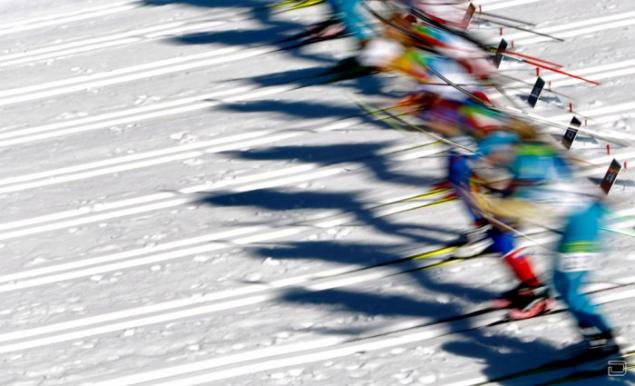
Photo by: Matthias Schrader
Source:http://www.boston.com/bigpicture/2010/03/vancouver_2010_part_2_of_2.html
Year Created: 2010
Analysis
Exposure time: A slow shutter speed was used, therefore creating a blurred effect. This shows the movement that is occurring.
Use of Shadows: Shadows were used to create a more artistic effect and add interest to this image. The shadows also create lines and help to show what the subject is.
Use of Color: This photograph is in color. The different colors in the uniforms help to distinguish that these are different people. If the photograph had been in black and white, the separation of the subject into individual people would be less clear.

I chose this photograph because we are currently at the end of week two of the Olympics. One of my favorite events happens to be the Biathlon. I always forget that I love images of sports and the various ways they can be represented as images. I found this image to be interesting because of the unusual nature of the blurry subjects, which are in motion.


Photo by: Matthew Brady
Source:http://www.npg.si.edu/exhibit/uniongenerals/#6
Year Created: 1862
Analysis
Lighting : The subject is appropriately lit with soft light. The image has a soft feel and does not have too much contrast.
Sharpness: The image is sharply focused giving a more serious appearance.
Background: The background is plain and therefore does not distract from the subject.

I was drawn to this image because I found the pose of the subject to be interesting and unusual. The way he is leaning with his arm and crossing his legs almost looks casual, while this is a very formal portrait. This portrait was with a series of others, all of which were stiff and formal.


Photo by: Sergey Gapon
Source: http://www.theatlantic.com/infocus/2014/02/kiev-truce-shattered-dozens-killed/100685/
Year Created: 2014
Analysis
Subject's Expression : The subject's expression is appropriate for the situation. He looks exhausted unhappy. This does not seem to be a posed subject. HE looks like he could be in a quiet moment, deep in thought.
Obvious Main Subject: The main subject in the image is obvious. It takes up most of the frame. If the cross and the shield were cropped out there would not be a context for this photograph and it would not be as interesting.
Composition Clutter: The composition is simple. The background is blurred by billows of smoke, and there is nothing in the image to distract the viewer from the subject.

This image was interesting to me because of the subject. The first piece of this image that I noticed was the cross, with my eyes moving to his yellow religious garment. I was interested to know who this man was and what was going on. I also find it interesting that this picture is from a few days ago and he is carrying what seems to me to be a medieval shield.

Photo by: Matthias Schrader
Source:http://www.theatlantic.com/infocus/2014/02/2014-sochi-winter-olympics-part-i/100678/
Year Created: 2014
Analysis:
Contrast: There is a high level of contrast in this photograph. It creates a dramatic effect and draws the viewer in.
Exposure Time: The image is sharp and motion is frozen, therefore a fast shutter speed was used.
Lines: The lines in this photograph draw the viewer's attention from the lower right corner up in a diagonal, which mimics the motion that is occurring in the image.

I chose this image because I am interested in looking at images of sports. The photographer also created the first picture that is listed above of the Biathlon event. I like the contrast and the way the lines draw your attention up in the direction of the motion. Even though this is technically a color photograph, I like the fact that it is mostly in gray tones.


Photo by: Ryan Mercer
Source:http://www.burlingtonfreepress.com/article/20140122/NEWS02/301220031/Fire-consumes-home-Worth-Skis-co-owner
Year Created: 2014
Analysis
Focus: This image is a little soft and out of focus. It seems to have been taken without a flash, which could help to create this effect. The soft focus helps to give the image a hazy, almost confused and dream like look.
Rule of Thirds: It's tricky to evaluate this photograph using the rule of thirds. It's hard to say what the subject is. The firefighter, or perhaps the fire itself? The combination of the firefighter with the fire to the right creates an overall subject that is off center and follows the "rule".
Feelings: The image creates the feeling of a hazy, dream-like state. It almost seems like all is quiet, however, to think about what is going on, it probably isn't. This image captures a still moment in chaos.

This image captured my attention because of the still, quiet feeling it evokes. Intellectually, it seems obvious that there is more going on in the photograph, however the photographer captured what seems to be a lull in the action.

Photo by: Stanley Kubrick
Source: http://mashkulture.net/2011/11/30/stanley-kubricks-photos-of-1940s-new-york/
Year: 1940

Analysis:

Lines: The use of lines in the image draws the viewer's attention in from the bottom and down the street.
Depth of Field: The background is somewhat in focus, allowing the viewer to experience the full depth of the street down which this woman is walking.
Background: The background provides context for and does not detract from the subject.

I chose this image because of the depth of field. The image comes to life and i can imagine being there. The woman is intriguing because even though this image is take in the 1940's, her outfit is timeless and could probably still be worn today.

Friday, February 14, 2014

Chapter Two- Pre-Digital Photographic Technology

Image by: Lance Pettiford

The dry plate collodion process in photography was first created in 1857 by Dr. Richard Norris.  In 1871, Dr. Richard Leach Maddox began to use an emulsion of gelatin and silver bromide on a glass plate. This became more popular and in 1878 dry plates began being manufactured commercially. This event is thought to have been the beginning of the modern era of photography. It was no longer necessary to have a portable darkroom to develop prints.1 By 1880, “George Eastman, age 24, sets up Eastman Dry Plate Company in Rochester , NY.” Shortly after this, the first half tone photograph appeared in the New York Graphic, which is a daily newspaper.2  
Photo by: Leonard Dakin
The emergence of this technology changed photography and photojournalism in many ways. First, it was no longer necessary to have a portable darkroom. Gone were the days of Roger Fenton’s photographic van. Secondly, the gel emulsion was more sensitive than the collodion plates, meaning that the exposure time was greatly reduced. This also made tripods unnecessary, in many situations where they were previously needed.  Hand held cameras could be marketed and mass produced allowing photographers to take “instantaneous snapshots”.1  The Kodak camera was a popular brand. “In place of glass plates, the camera contained a roll of flexible negative material sufficient for taking 100 circular pictures, each roughly 2.5 inches (6 cm) in diameter.”1

These developments in technology allowed the field of photojournalism to blossom. There was increased ease in taking and producing pictures. As Professor Nordell states in the course content video, “Eastman revolutionized photography by bringing it to the masses.” With shorter exposures, photojournalists weren’t limited to stiff portraits where the subject’s head was held still by a stand or dead bodies after a battle. The shorter exposure time meant that other subject matter could be more successfully photographed.
Photo by: M. Travers

Photo by: M. Travers


The photographs above were taken using a DSLR, or digital single-lens reflex camera with auto focus. In the DSLR, much like the SLR, or single-lens reflex camera the photographer look through the lens and is able to see exactly what the photograph will look like. The cameras that Eastman manufactured using dry plate technology did not have this feature. In fact, the DSLR does not create prints by recording images on dry emulsions. Instead, the image is captured by the camera’s sensor after the shutter has been opened and is converted into a digital signal by the camera’s processor chip.3 Clearly, it is much easier today to take a photograph of a desired image with the desired outcome. With this digital technology there is little processing time as long as you are not editing it using software.  Images taken on DSLR’s can even be transmitted to computers via wireless connections. This greatly enhances the potential of photojournalists to take literally thousands of pictures and capture that one shot that becomes history. The time needed to take the same amount of photographs, develop them, and sort through the images using dry plate emulsion, and a camera such as the Eastman camera would be extensive.

References:

Friday, February 7, 2014

Chapter One- Can Photographs Change the World?


Can photographs change the world? I believe they can. Photographs have long been a means to helping us understand the social environment and changes that are happening all around us. Whether it is the horror of war, the beauty of nature, or the essence of humanity, photographs speak to us all in some way. This is especially true now that images are distributed quickly and widely through social media and online.

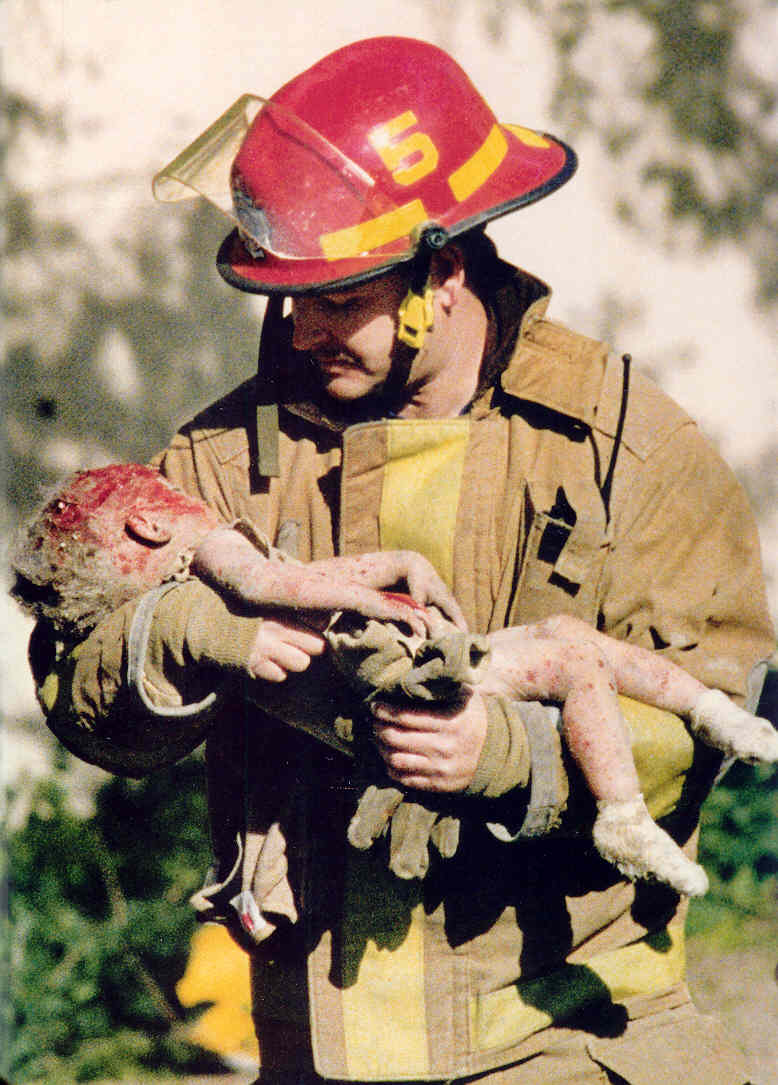
 In researching iconic photographs for this project, I came across the photograph above,  taken by Charles Porter, an amateur photographer, of a firefighter carrying a dying child from the rubble after the Oklahoma City bombing in 1995. This image had a profound effect on me then, and has even more of an impact on me now that I am the parent of a small child. To me, this image captures both the terrible tragedy of life and the beauty of the human spirit at the same time. The innocent child is dying as the result of a violent and despicable act. This is captured in the image. However, we see a true picture of humanity in the way the firefighter is gently cradling her, with his gloves off, and a caring and sorrowful expression on his face. To this day, I actually find this photograph to be quite upsetting, while also being comforting and beautiful at the same time. It is comforting to see how she is being cared for, even loved in her last moments by a total stranger.


Photo by: Simon Maina

Photographs of victims of famine can be difficult to look at. However, they have been a catalyst for bringing attention to the world wide problem of hunger. As a result, there have been many campaigns to help raise funds to support this cause. This is one way that photographs can change the world, by literally opening our eyes to something we may not otherwise realize is occurring and rallying support around a cause.

A picture is truly worth a thousand words. I believe photographs change the world by opening our eyes to worlds that written descriptions couldn't even begin to explain. The evidence presented in photographs is unwavering, even though they can be the result of a bias. Photographs have the power to elicit great emotions, which lead people to become passionate and create change. Therefore giving photographs the power to change the world.

Friday, January 31, 2014

An introduction to the History of Photojournalism


Source: http://www.cah.utexas.edu/news/press_release.php?press=press_news_to_history

According to Merriam-Webster Online , photojournalism is “the job or activity of using photographs to report news stories in magazines or newspapers.” Photographers use their pictures to tell stories. I would expand this definition to include photographs that are presented in formats other than in print in magazines and newspapers. I do not feel that the definition of photojournalism should be strictly limited to prints in magazines and newspapers.  I believe that there are all sorts of other formats today including online and gallery style shows.  To me, photojournalism is really a style of photography that documents and provides a photographic record of events as they are occurring.
Self-portrait of photojournalist Robert Capa
Photo by: Robert Capa

     This has led me to ponder the question, “What is the difference between documentary photography and photojournalism?” It seems to me that one major difference is that the subjects of photo journalistic photos are more immediate and capture action at a specific event or time; whereas the subjects of documentary photos are typically longer term, and project based. I found an in depth explanation on a blog written by Tony Bridges which I think is worth a read. It is interesting to note that both photo journalistic and documentary photographs are usually published in magazines and newspapers, as well as other formats such as online. I feel that documentary photography could be a subset or type of photojournalism.
From a documentary series on Appalachia
Photo by: Milton Rogovin
Source: http://www.swiatobrazu.pl/dynamiczny_stulatek_milton_rogovin.html

     Why should we study the history of photojournalism? Studying the history of anything helps us to further understand the subject. Looking at the origins and evolution of photojournalism helps us to understand the craft as an art form, and also sheds light upon various trends in the craft and subject matter at the time that certain photographs were taken.  Photographs that are published and popular tend to reflect the public interest and the social climate of the time. One example we saw in this module was of the photo editors in the "In Harm's Way" video Zoriah and Alissa each met with photo editors to find out what stories were of interest to the people in the areas in which they were shooting.


Friday, January 24, 2014

Migrant Mother

Photo by: Dorothea Lange
Image Source: http://www.loc.gov/wiseguide/may10/picture.html

When I think of photojournalism the images that come to mind and often are the most striking to me personally are those that convey humanity in difficult or tragic events. I think that seeing human nature shine through conveys hope even in the face of tough times. I have always thought this picture is strikingly beautiful, as it conveys the love of a family and the reality of the hard times families faced throughout the Great Depression. This picture paints an honest picture of what was going on at that particular moment.